



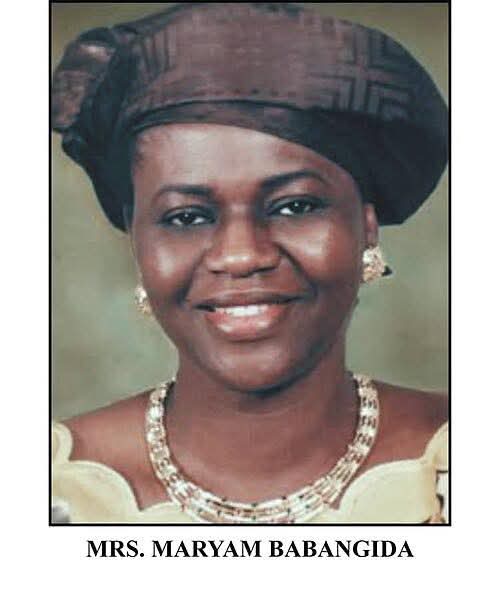
In Nigeria’s modern political history, few First Ladies reshaped public expectations as profoundly as Maryam Babangida. Her tenure marked a turning point when the role of the First Lady evolved from a quiet ceremonial presence into a structured platform for national development, especially for women at the grassroots.
Serving as First Lady of Nigeria from August 27, 1985, to August 26, 1993, during the military administration of General Ibrahim Badamasi Babangida, she left behind a legacy that continues to influence women-focused policy and advocacy in Nigeria today.
Born on November 1, 1948, in Asaba (present-day Delta State), Maryam King came from a culturally diverse background. Her father, Leonard Nwanonyei King, was from Asaba, while her mother, Asabe Halima Mohammed, had northern roots from Kaduna State. This blend of South and North shaped her pan-Nigerian identity and broadened her cultural outlook from an early age.
Her early education began in Kaduna before she moved to the South-West, where she attended Queen of Apostles College (now Mary Immaculate Grammar School) in Ogwashi-Uku. She later pursued professional and business-oriented studies, including secretarial training at the Federal Training Centre in Kaduna and further studies at La Salle Extension University in Chicago, reflecting her interest in administration and enterprise.
On September 6, 1969, she married then-army officer Ibrahim Badamasi Babangida. Their marriage lasted over four decades and produced four children. Long before entering the national spotlight, she was already active in military social structures, serving as President of the Nigerian Army Officers’ Wives Association (NAOWA) from 1984 to 1985. In that role, she supported initiatives focused on education, healthcare, and welfare for military families through NAOWA.
Her most defining transformation came after 1985, when her husband became Head of State. Unlike previous First Ladies who operated informally, Maryam Babangida institutionalized the office itself. She established a structured First Lady’s office with defined programs, personnel, and development mandates — an innovation that permanently changed the expectations of the role in Nigeria.
Her most impactful initiative was the Better Life for Rural Women Program, launched in 1987. Through this platform, she redirected national attention toward rural communities, where the majority of Nigerian women lived and worked. The program promoted cooperative societies, small-scale industries, agricultural support systems, and literacy initiatives aimed at economic empowerment.
This movement led to the creation and strengthening of key national institutions, including the National Centre for Women Development, which continues to serve as a policy and training hub for women’s advancement in Nigeria.
Under her leadership, thousands of women’s cooperatives were encouraged across the country, giving rural women greater access to credit systems, training, and local enterprise opportunities. Her approach shifted the national conversation from charity-based support to structured economic empowerment.
Beyond policy, Maryam Babangida became a global symbol of African elegance and cultural pride. Her public image — marked by refined traditional fashion and confident presence — helped elevate Nigerian aesthetics on the international stage. She was widely recognized for using cultural identity as a form of soft power diplomacy.
In recognition of her continental influence, she received international honors, including the Africa Prize for Leadership for the Sustainable End of Hunger in 1991, highlighting her role in advancing grassroots development initiatives.
Her husband, General Ibrahim Badamasi Babangida, remains one of Nigeria’s most studied political leaders, and together their era remains one of the most consequential in Nigeria’s military governance history.
Maryam Babangida passed away on December 27, 2009, in Los Angeles, California, after a battle with ovarian cancer, at the age of 61. Her passing marked the end of an era, but her institutional legacy continues to shape women-focused programs across Nigeria.
More than a First Lady, she redefined what influence could mean in governance — not as symbolic presence, but as structured national impact.
If leadership is measured by systems built rather than titles held, then Maryam Babangida’s legacy deserves remembrance as one of the most transformative in Nigeria’s modern history — a woman who gave visibility, voice, and institutional direction to millions of Nigerian women.
#NigerianHistory #WomenEmpowerment #MaryamBabangida #LeadershipLegacy #Heart2HeartWithSammy
©️Heart 2 Heart With Sammy
*Confluence News Reporting from Minna,Niger State*