


Early Life & Education:
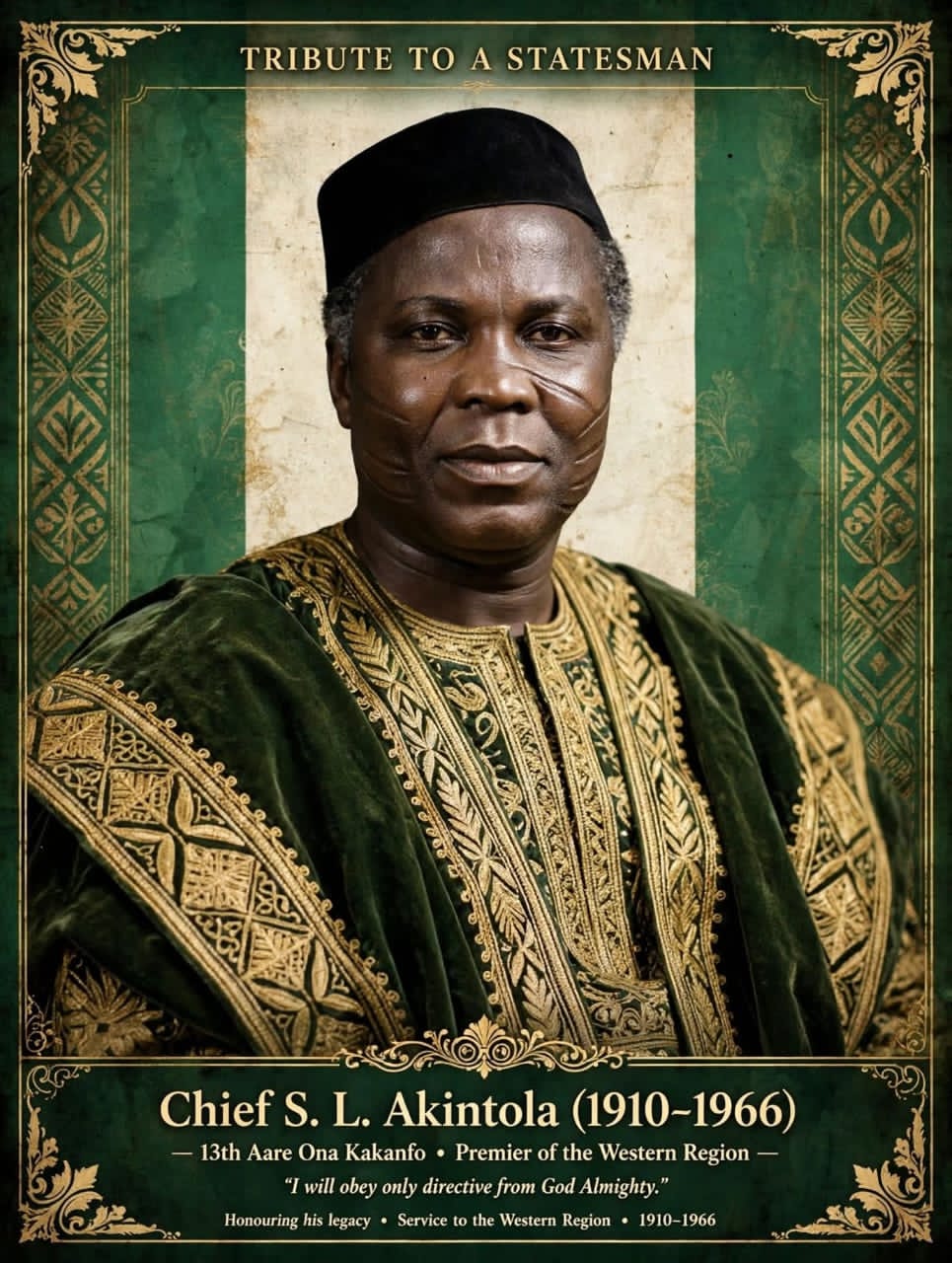
Born July 6, 1910*l in Ogbomoso to a wealthy warrior family — father Akintola Akinbola and mother Akanke.
His family moved to Minna, Niger State in 1914 where he started school at C.M.S Minna.
He learned 4 languages there: English, Yoruba, Hausa and Nupe. In 1922 he returned to Ogbomoso to live with his grandfather and attended Baptist Day School 1922-1925, then Baptist College Ogbomoso.
He became a brilliant teacher — he taught at Baptist Academy Lagos for 12 years (1930-1942) teaching Science, Biology and Bible. He was also a Baptist Lay Preacher. 1822.
From Railway to Journalism to Law:
Tired of teaching, he joined Nigerian Railway Corporation in 1942 briefly, then switched to journalism — he joined Ernest Ikoli’s _Nigerian Daily Service_ and rose to become Editor.
He later travelled to England, studied journalism at London School of Journalism, Fleet Street, then studied Law and was called to the Bar in London in 1946. He returned to Nigeria in 1949 and set up his law firm in Lagos. 1822
He was known as a great orator — Awolowo said he could argue both sides of an issue with equal dexterity — and a polyglot.
Political Career
On return in 1949, he teamed up with Chief Obafemi Awolowo and others to form the Action Group (AG)— the dominant Yoruba party.
He was legal adviser and after the death of Bode Thomas in 1953, he became Deputy Leader of AG.
He didn’t serve in the Western Region government under Awolowo, but was AG Parliamentary Leader / Leader of Opposition in the Federal House of Representatives in Lagos.
At federal level he served as Minister of Labour, Minister of Health (instrumental in building UCH Ibadan) and Minister for Communications and Aviation. 1ea7
The Big Switch and Break up with Awolowo:
In late 1959, as independence approached, AG decided Awolowo would move to Federal Parliament as Leader of Opposition, and Akintola would become Premier of Western Region. So from Oct 1, 1960, Akintola became Premier of Western Nigeria.
Problem started: Awolowo wanted democratic socialism, Akintola was more conservative and wanted to align Western Region with the ruling NPC/NNDP at the centre for power sharing. This ideological clash led to a serious crisis.
In 1962, after a vote of no-confidence, Akintola was removed as Premier by Governor Oladoke Akintola’s own party. Federal Government declared State of Emergency in Western Region (1962) — first time in Nigeria. Akintola was later reinstated by court.
He then left Action Group and formed Nigerian National Democratic Party (NNDP) in 1963, which allied with the Northern NPC. He was re-elected Premier in the highly controversial and violent 1965 Western Region elections that triggered Operation Wetie— political thugs burning houses and people with petrol. Western Nigeria became ungovernable.
Titles and Personality:
He was titled Oloye Aare Ona Kakanfo XIII of Yorubaland — the generalissimo of Yoruba army — a very revered title.
He was known for eloquence, charisma, humour, and flamboyance. He was reportedly the first Nigerian to import a bullet-proof car (£8,000 then).
Married to Faderera Akintola, with 5 children including Ladiran, Yomi, Tokunbo etc.
Assassination:
On January 15, 1966, during Nigeria’s first military coup led by Major Chukwuma Kaduna Nzeogwu, soldiers invaded his residence in Ibadan. Unlike other politicians who tried to escape, Akintola fought back. He was shot dead at age 55 in Ibadan.
His death marked the end of the First Republic. The Ladoke Akintola University of Technology (LAUTECH) in Ogbomoso was named after him in his memory.